
Competing with larger brands online can be challenging for small businesses. Bigger companies often have established websites, extensive content libraries, strong brand recognition, and larger marketing budgets. However, AI-powered search is creating new ways for customers to discover businesses based on the relevance and usefulness of their information.
When people use conversational search tools or AI-generated summaries, they may ask detailed questions, compare providers, and look for recommendations before making a decision. Small businesses can improve their chances of being discovered by clearly explaining their expertise, answering customer questions, and maintaining a trustworthy online presence.
AI brand visibility is not simply about appearing in ChatGPT or Google AI Overviews. It is about making your business information accessible, relevant, and useful wherever potential customers search.
How Can Small Businesses Improve AI Brand Visibility?
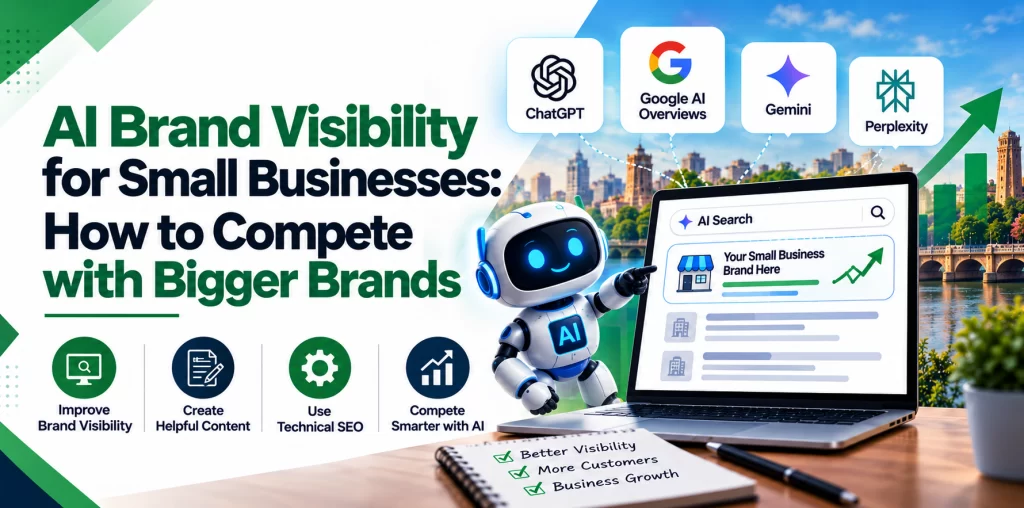
Small businesses can compete with larger brands in AI search by focusing on specific customer needs, publishing helpful content, strengthening technical SEO, and building genuine credibility.
Key actions include:
- Create useful content that answers questions within your niche.
- Optimise service pages for relevant search intent and customer problems.
- Ensure important website pages are crawlable and indexable.
- Maintain consistent, accurate business information online.
- Publish original insights, case studies, and examples of expertise.
- Monitor brand visibility across relevant AI search experiences.
- Improve content and website performance using real data.
AI Brand Visibility Optimization combines these activities to help search systems understand a business’s services, expertise, and relevance. Google confirms that established SEO fundamentals remain important for AI search features, but no particular tactic guarantees inclusion in AI-generated answers.
1. Focus on a Specific Niche Instead of Competing Everywhere
One advantage small businesses have is the ability to serve a specific audience or solve a clearly defined problem. Rather than trying to compete with major brands for every broad keyword, identify the customer groups and topics where your business can provide the most value.
For example, a small accounting firm may focus on tax planning for freelancers, while a local digital agency may specialise in SEO for healthcare clinics or restaurants. This focus helps the business create relevant service pages and detailed resources for its intended audience.
Start by identifying:
- The customers most likely to benefit from your services.
- The problems they need to solve.
- The questions they ask before purchasing.
- The expertise or experience that differentiates your business.
- The geographic areas or industries you genuinely serve.
Build your content strategy around these areas. Specific, useful information can make your business more relevant to particular searches without requiring the same volume of content as a large competitor.
2. Create Helpful Content That Demonstrates Expertise
Large brands may have more published pages, but quantity alone does not make content valuable. Small businesses can stand out by providing practical information drawn from real experience.
Create articles, guides, FAQs, comparison pages, and service explanations that help potential customers make informed decisions. Instead of publishing another generic list of tips, include examples, explain trade-offs, and address questions that competitors overlook.
For example, a web development business could publish a guide explaining how a small company can choose between a website redesign and targeted performance improvements. A local service provider could explain common pricing factors and what customers should ask before hiring a professional.
Use descriptive headings, direct answers, clear examples, and relevant internal links. Review content regularly to remove outdated claims and correct inaccurate information.
Google’s guidance recommends creating original, helpful, reliable content for people rather than producing pages primarily to manipulate rankings.
3. Make Your Website Easy for Search Systems to Understand
Even excellent content needs a sound technical foundation. If search engines cannot access important pages or understand how they relate to one another, your business may miss relevant discovery opportunities.
Review your website for these issues:
- Important pages accidentally blocked from crawling or indexing.
- Incorrect canonical tags and duplicate URLs.
- Broken internal links and orphan pages.
- Unclear page titles and headings.
- Slow loading pages or difficult mobile navigation.
- Important information hidden behind inaccessible interactions.
Use Google Search Console to inspect indexing status and identify technical problems. Ensure your service pages can be reached through logical navigation and relevant internal links.
Keep business details, services, and contact information clear. Structured data can also help describe certain types of information when implemented correctly, but special schema markup is not a requirement for appearing in Google AI Overviews.
A technically accessible website gives your content a stronger foundation for discovery, although indexing alone does not guarantee visibility.
4. Strengthen Brand Visibility in ChatGPT and Other AI Search Tools
AI search experiences can present different answers depending on the question, available sources, and context. Your business might appear for a specific service query but not for a broader industry question.
To understand your current visibility, create a list of realistic customer questions. Include searches about your services, common problems, comparisons between solutions, and relevant local needs.
Record whether your business appears, whether your website is referenced, which competitors are mentioned, and whether the information is accurate. Repeat the same tests periodically so you can compare observations over time.
Do not treat a single AI-generated answer as a definitive ranking report. Responses can change, and visibility across one tool does not automatically translate to another.
Improve the pages most relevant to your target queries. Clearly explain what your business does, who it serves, what makes its approach useful, and how customers can verify your claims.
5. Build Credibility Through Genuine Online References
Small businesses do not need thousands of brand mentions to build a credible online presence. They need accurate information and relevant evidence that supports their expertise.
Useful credibility signals can include:
- Genuine customer reviews.
- Detailed case studies and project examples.
- Author biographies and professional experience.
- Relevant industry publications mentioning your work.
- Accurate business profiles and directory listings.
- Partnerships and professional affiliations that genuinely exist.
Avoid purchasing irrelevant mentions or creating artificial endorsements. These activities do not establish genuine expertise and can undermine trust.
For local businesses, maintain an accurate Google Business Profile when eligible, and ensure contact details are consistent across relevant platforms. Publish local content when it helps customers understand your services or the area you serve.
The goal is to make it easier for people to verify your business and understand why it may be relevant to their needs.
6. Use AI Brand Visibility Optimization to Identify Opportunities
A structured AI Brand Visibility Optimization process helps small businesses understand their current position and decide which improvements deserve attention first.
An effective review can assess technical accessibility, content quality, brand information, relevant search queries, and the visibility of key service pages.
For businesses targeting local customers, AI Search Visibility Services in Ahmedabad may involve reviewing how clearly the website communicates its services, geographic relevance, and expertise. The findings should lead to practical recommendations rather than promises of guaranteed AI mentions.
Prioritise improvements according to their likely value and implementation effort. Fixing an important indexing issue may be more urgent than rewriting an already useful article. Improving a core service page may offer more commercial value than publishing several unrelated blog posts.
Use the audit as a working plan that connects SEO improvements with customer needs and business objectives.
7. Measure Results Without Relying Only on Rankings
Traditional keyword positions are useful, but they do not tell the whole story about brand visibility.
Track a combination of indicators:
- Search impressions and organic clicks.
- Indexing status of important pages.
- Traffic to service pages and useful articles.
- Enquiries, calls, and qualified leads.
- Brand appearances in a consistent sample of AI search queries.
- Accuracy of the information presented about your business.
Google Search Console can help monitor traditional search performance. Analytics tools can show whether visitors complete valuable actions. Use available AI search reporting where applicable, and document manual visibility checks consistently.
Small businesses should focus on measurable progress rather than expecting immediate results from every change. Search behaviour, competitors, and AI-generated responses can evolve, so review the evidence and adjust the strategy over time.
8. Compete Smarter With a Practical Action Plan
You do not need a large marketing team to begin improving your AI brand visibility. Start with a manageable plan.
Week 1: Audit your foundations. Check indexing, important service pages, internal links, business details, and existing organic performance.
Week 2: Improve key content. Update the pages most relevant to your customers, answer common questions, and add genuine examples of expertise.
Week 3: Strengthen credibility. Review business profiles, request honest customer feedback where appropriate, and identify relevant opportunities to share original insights.
Week 4: Measure and prioritise. Test selected AI search queries again, review available analytics, and decide which improvements to tackle next.
SEO-Ahmedabad can help small businesses evaluate their SEO foundations, content strategy, and AI search visibility opportunities through a structured, evidence-based approach.
Conclusion
Small businesses can compete more effectively in AI search by focusing on relevance, expertise, technical accessibility, and customer needs rather than trying to match the content volume or marketing budgets of larger brands.
Start with a clearly defined audience, improve your most important pages, publish useful information, and build genuine credibility across relevant platforms. Measure progress through search performance, customer enquiries, and repeatable AI visibility checks.
www.seo-ahmedabad.com can support a practical strategy that connects traditional SEO with evolving AI search experiences. The aim is to make your business easier to discover, understand, and evaluate without relying on guaranteed rankings or artificial brand mentions.
Frequently asked question
AI Brand Visibility Optimization is the process of improving how clearly a business's identity, services, expertise, and useful content can be discovered across AI-powered search experiences.
Yes, small businesses can target specific customer needs, demonstrate practical expertise, and create more relevant content for their audiences. Results depend on competition, relevance, website quality, and other factors.
Make your website accessible, publish accurate and helpful content, maintain consistent business information, and test relevant customer queries. No particular action guarantees a mention in ChatGPT responses.
Google states that established SEO best practices remain relevant to AI Overviews. Focus on crawlability, useful content, clear website structure, and accurate information rather than relying on unverified AI-specific tricks.
There is no fixed timeline. Improvements depend on the website's starting condition, competition, content quality, and how search systems discover and use information. Monitor progress over time instead of expecting a guaranteed date.
