

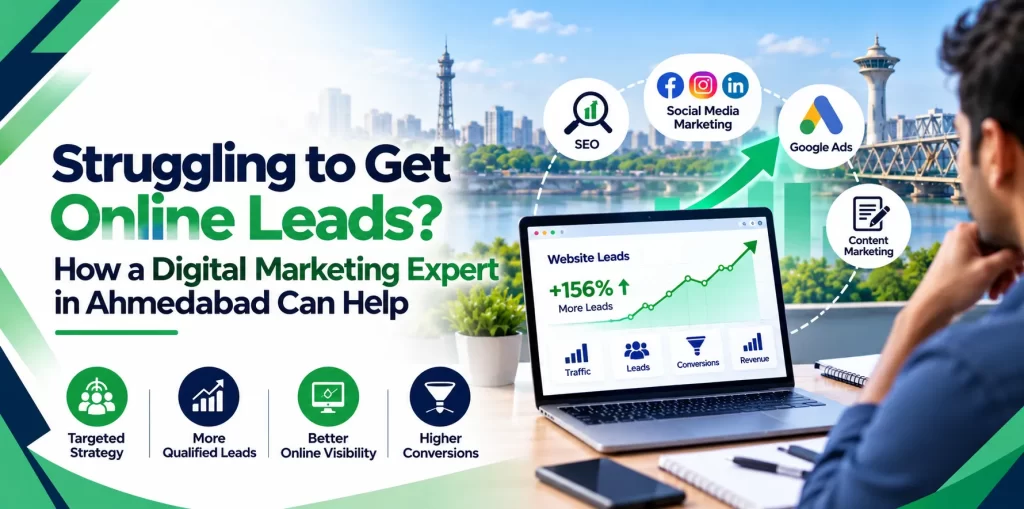
Getting website visitors but not enough enquiries can frustrate any business. You may be investing in a website, publishing content, or running advertising campaigns, yet your phone remains quiet and your contact forms receive very few submissions. The problem may not be traffic alone. Your marketing strategy may need better targeting, stronger conversion paths, or more effective follow-up.
A well-planned digital marketing strategy connects your business with relevant audiences and encourages them to take meaningful actions. Working with a Digital Marketing Expert in Ahmedabad can help businesses identify gaps in their online presence, improve campaign performance, and develop a clearer process for generating qualified leads.
From search engine optimization and paid advertising to landing page improvements and conversion tracking, the right approach focuses on measurable business outcomes rather than simply increasing clicks.
How Can a Digital Marketing Expert Help Generate More Leads?
A digital marketing expert can help businesses generate online leads by identifying the right audience, improving website visibility, creating targeted campaigns, and optimizing the visitor journey from discovery to enquiry.
Key activities include:
- SEO: Improve organic visibility for relevant searches.
- Paid advertising: Reach potential customers through targeted campaigns.
- Landing page optimization: Make it easier for visitors to understand your offer and contact your business.
- Content marketing: Answer customer questions and build trust.
- Conversion tracking: Measure calls, forms, bookings, and other meaningful actions.
- Lead follow-up: Help create a process for responding to enquiries and moving prospects toward a purchase.
Results depend on the business, industry, competition, budget, offer, and quality of implementation. A structured strategy helps identify which activities contribute most effectively to lead generation.
1. Understand Why Your Website Is Not Generating Leads
Before investing more money in marketing, identify where potential customers are dropping out of the buying journey. A website can receive substantial traffic but generate few enquiries if visitors are not relevant, the offer is unclear, or the next step is difficult to find.
Start by reviewing the following questions:
- Are visitors arriving through searches relevant to your services?
- Does your homepage explain what your business offers?
- Can users easily find your phone number, contact form, or enquiry button?
- Do landing pages address the problems your audience wants to solve?
- Does your website work properly on mobile devices?
- Are calls, forms, and other conversions being tracked accurately?
Google Analytics and Google Search Console can help you understand website engagement, search performance, and user journeys. Advertising platforms can provide additional information about campaign costs and conversions.
A structured audit helps distinguish between a traffic problem and a conversion problem. This prevents businesses from spending more on campaigns when the website itself needs improvement.
2. Reach the Right Audience Through SEO
Search engine optimization helps your website appear for relevant searches when potential customers are researching products or services. Unlike advertising, organic SEO does not charge for each click, although it requires ongoing investment in content, technical improvements, and optimization.
An effective SEO strategy begins with understanding the terms your target customers use. For example, a local service business may need service-specific pages, location-relevant information, useful FAQs, and clear contact details.
A digital marketing professional can help with:
- Keyword research based on customer intent.
- On-page optimization of titles, headings, and content.
- Technical SEO audits and indexing checks.
- Local SEO improvements for relevant location-based searches.
- Helpful blog content that answers customer questions.
- Internal linking and website structure improvements.
For local businesses, a well-maintained Google Business Profile can also support discovery in relevant local searches. Keep business details accurate and encourage genuine customer reviews without offering incentives that violate platform policies.
SEO generally takes time, and ranking improvements do not guarantee leads by themselves. The objective is to attract relevant visitors and give them a clear reason to contact your business.
3. Use Paid Advertising to Reach Potential Customers
Paid campaigns can help businesses reach people searching for particular services or matching defined audience criteria. Google Ads and social advertising platforms offer different targeting options, making campaign selection dependent on your audience and buying journey.
Search advertising may be suitable when customers actively search for a service. Social media advertising can help introduce an offer to relevant audiences or re-engage eligible visitors, subject to platform policies and consent requirements.
To improve campaign efficiency, focus on:
Clear targeting: Choose relevant locations, search terms, audiences, and campaign objectives.
Relevant ad copy: Make sure the advertisement reflects the service or offer on the landing page.
Budget control: Set realistic spending limits and monitor cost per qualified inquiry.
Negative keywords: Exclude irrelevant searches where appropriate.
Conversion measurement: Track meaningful actions instead of judging success by clicks alone.
A campaign that generates many low-quality inquiries may be less valuable than one producing fewer, more relevant leads. Evaluate lead quality and business outcomes before increasing the budget.
4. Improve Landing Pages and Calls to Action
Even well-targeted visitors may leave if your website does not clearly explain what to do next. Landing pages should make the value proposition understandable, answer important questions, and provide a convenient way to inquire.
A strong landing page typically includes a clear headline, a concise explanation of the service, relevant benefits, trust signals, and an obvious call to action.
Consider these improvements:
- Use a headline that matches the visitor’s search or advertisement.
- Explain who the service is for and which problem it addresses.
- Include genuine testimonials or case studies when available.
- Make phone numbers and enquiry buttons easy to find.
- Keep contact forms short and request only necessary information.
- Improve mobile layout, readability, and loading performance.
Test changes systematically. For example, compare two headline variations or different form layouts while keeping other conditions as consistent as possible. Measure completed enquiries and lead quality, not just button clicks.
5. Create Helpful Content That Builds Trust
Potential customers often research a business before making contact. They may compare providers, look for pricing information, investigate common problems, or check whether a service meets their needs. Useful content helps answer these questions and gives visitors a reason to trust your expertise. Depending on your industry, content opportunities may include service guides, frequently asked questions, comparison articles, project examples, and practical advice.
A content strategy should reflect genuine customer concerns rather than simply publish articles to include keywords. Each page should have a clear purpose and offer useful information. SEO Ahmedabad can help businesses evaluate how content, search visibility, and website experience work together within a broader lead-generation strategy.
6. Use Local Digital Marketing to Attract Ahmedabad Customers
Businesses serving a defined geographic area can benefit from marketing that reflects local customer needs. This may include location-relevant service pages, accurate business listings, local search optimization, and targeted campaigns for appropriate service areas.
However, adding a city name repeatedly to every page is not a complete local SEO strategy. The content should explain which services are available, who they help, and what makes the business relevant to local customers.
Consider these practical steps:
- Maintain accurate business name, address, phone number, and operating hours.
- Optimize relevant service pages for local search intent.
- Keep your Google Business Profile updated.
- Publish useful examples of work or services where appropriate.
- Encourage honest customer feedback.
- Use location targeting carefully in paid campaigns.
Local visibility should be supported by a clear service offering and a reliable way for customers to contact you. Avoid creating misleading location pages for areas where your business has no genuine relevance.
7. Track Leads and Measure Marketing Performance
Without reliable tracking, it is difficult to determine which marketing activities generate useful enquiries. Businesses should establish a clear measurement system before making major campaign changes.
Useful metrics include:
- Qualified leads: Enquiries that match your target customer profile.
- Conversion rate: The proportion of relevant visitors who complete a desired action.
- Cost per lead: Marketing expenditure divided by the number of leads generated.
- Lead-to-customer rate: The proportion of leads that become paying customers.
- Customer acquisition cost: The cost of acquiring a customer through the measured channels.
- Return on marketing investment: The business value generated relative to marketing expenditure.
Configure tracking for forms, phone calls, bookings, and purchases where appropriate. Use consent-aware analytics practices and verify that events are recorded correctly.
Review lead quality with your sales team. If many enquiries are irrelevant, refine targeting and messaging. If leads are suitable but rarely convert, examine response times, sales processes, pricing, and customer communication.
8. Choose the Right Digital Marketing Support
Businesses may work with an individual specialist, a freelancer, or an agency depending on their budget, project scope, and internal resources. When you hire a Digital Marketing Expert in Ahmedabad, look for a professional who understands your business goals, explains the proposed strategy, and measures outcomes transparently.
Before making a decision, ask:
- How will you identify my target audience and lead-generation challenges?
- Which channels are suitable for my business, and why?
- How will you track qualified enquiries and campaign performance?
- What deliverables and reporting will I receive?
- How will you prioritize work within my budget?
- What results are realistic, and what factors could affect them?
A trustworthy professional should explain the strategy, costs, risks, and measurement process without guaranteeing a particular number of leads or rankings.
Conclusion
Generating online leads requires more than attracting website visitors. Businesses need relevant traffic, useful content, effective landing pages, accurate conversion tracking, and a reliable process for following up with prospects. A Digital Marketing Expert in Ahmedabad can help identify weaknesses, prioritize improvements, and build a strategy around measurable business objectives. By reviewing performance regularly and focusing on lead quality, businesses can make better-informed decisions about their marketing investments.
Frequently asked question
A specialist can improve search visibility, manage targeted advertising, optimize landing pages, create helpful content, and measure conversions to attract and convert more relevant prospects.
A freelancer may suit a focused project or smaller budget, while an agency may offer a broader range of services. Compare expertise, communication, deliverables, availability, and reporting before deciding.
Paid campaigns may generate inquiries soon after launch, while SEO and content marketing often require sustained work. Timing varies according to competition, budget, website quality, and the offer.
Track qualified leads, conversion rates, cost per lead, customer acquisition cost, and sales outcomes. Website traffic and clicks alone do not show whether campaigns are producing business value.
The appropriate budget depends on business goals, competition, customer acquisition economics, and available resources. Start with a defined objective, measure results, and scale spending based on evidence.
