

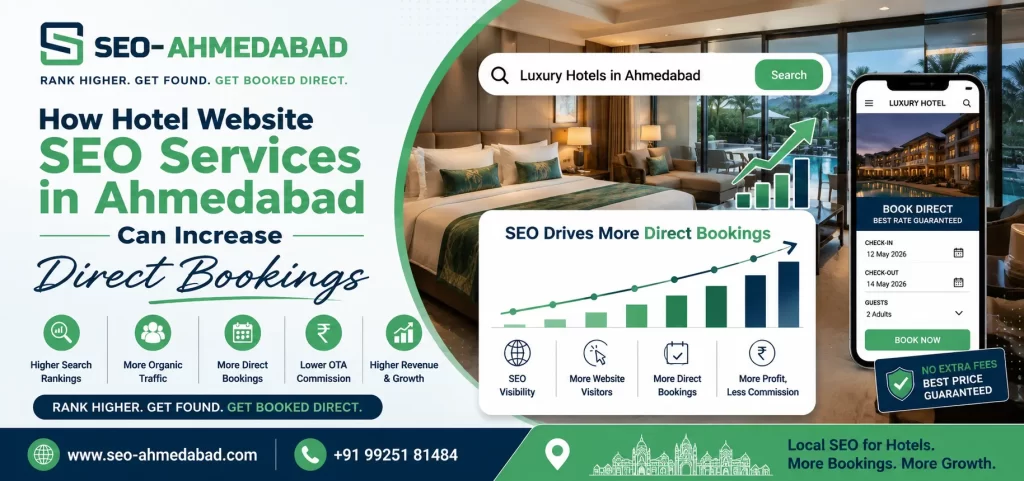
For hotels and resorts, getting more website visitors is useful only when those visitors turn into bookings. Many properties depend heavily on online travel agencies (OTAs), paid advertising, social media, and third-party booking platforms. While these channels can generate reservations, they can also involve commissions and intense competition. A well-optimized hotel website gives properties an opportunity to attract travelers directly through organic search and convert them into direct bookings.
This is where hotel website SEO services in Ahmedabad can make a difference. A strategic SEO campaign can help a hotel’s website appear for searches related to accommodation, locations, amenities, events, and travel experiences. For example, a hotel targeting Ahmedabad travelers may optimize pages around terms such as hotels in Ahmedabad, business hotels in Ahmedabad, luxury hotels, hotels near popular attractions, and specific accommodation requirements.
A professional Hotel SEO Company in Ahmedabad can combine technical SEO, local SEO, content optimization, conversion improvements, and keyword targeting to increase relevant organic traffic. The goal is not simply to achieve higher rankings but to attract users who are genuinely interested in staying at the property. This guide explains how hotel SEO can support direct bookings and what hotel owners should consider when developing an effective search strategy.
How Can Hotel SEO Increase Direct Bookings?
Hotel SEO can increase direct bookings by helping a property’s website appear for relevant travel searches, improving organic visibility, building trust, and creating landing pages that make it easier for visitors to book directly.
An effective strategy typically includes:
- Targeting high-intent hotel keywords
- Optimizing Google Business Profile
- Improving local search visibility
- Creating location and service-focused content
- Optimizing hotel room and amenity pages
- Improving website speed and mobile usability
- Using structured data where appropriate
- Creating compelling title tags and meta descriptions
- Making direct booking options highly visible
- Tracking organic traffic, leads, and booking conversions
SEO works best as a long-term acquisition channel rather than a quick replacement for OTAs.
1. Target Travelers Who Are Actively Searching
One of the biggest advantages of SEO is the ability to reach people while they are actively researching accommodation.
Travelers may search for:
- Hotels in Ahmedabad
- Best hotels in Ahmedabad
- Luxury hotels in Ahmedabad
- Business hotels in Ahmedabad
- Hotels near Ahmedabad airport
- Hotels near Ahmedabad railway station
- Hotels for business travelers
- Family hotels in Ahmedabad
- Hotels with conference facilities
- Hotels with restaurants
- Weekend stay options
These searches can reveal different levels of booking intent. Someone searching for “hotels in Ahmedabad” may still be comparing options, while a person searching for “hotel near Ahmedabad airport with parking” may have a more specific requirement. A strong SEO strategy targets both broad and highly specific search queries.
2. Build Visibility Beyond OTA Platforms
OTAs provide hotels with access to a large audience, but hotel websites can struggle to compete for visibility when travelers primarily see third-party booking platforms in search results.
SEO gives hotels another opportunity to appear in organic search.
Instead of relying exclusively on:
- Booking platforms
- Paid advertisements
- Travel websites
- Social media
- Referral traffic
A hotel can build its own search visibility.
The hotel website can become a valuable acquisition channel that brings users directly to the property. This does not mean eliminating OTAs. Rather, SEO can diversify the hotel’s booking sources and potentially increase the proportion of reservations generated through its own website.
3. Optimize Hotel Room and Service Pages
A hotel’s website should not have only a homepage and a generic “rooms” page.
Individual pages can target specific search intent.
For example:
Room Pages
Create dedicated pages for:
- Deluxe rooms
- Executive rooms
- Suites
- Family rooms
- Premium accommodations
Service Pages
Consider pages for:
- Restaurant
- Banquet hall
- Conference facilities
- Swimming pool
- Spa
- Wedding venue
- Business facilities
- Airport transfers
Each page provides an additional opportunity to rank for relevant searches. This approach also helps visitors find exactly what they are looking for before making a booking decision.
 4. Strengthen Local SEO
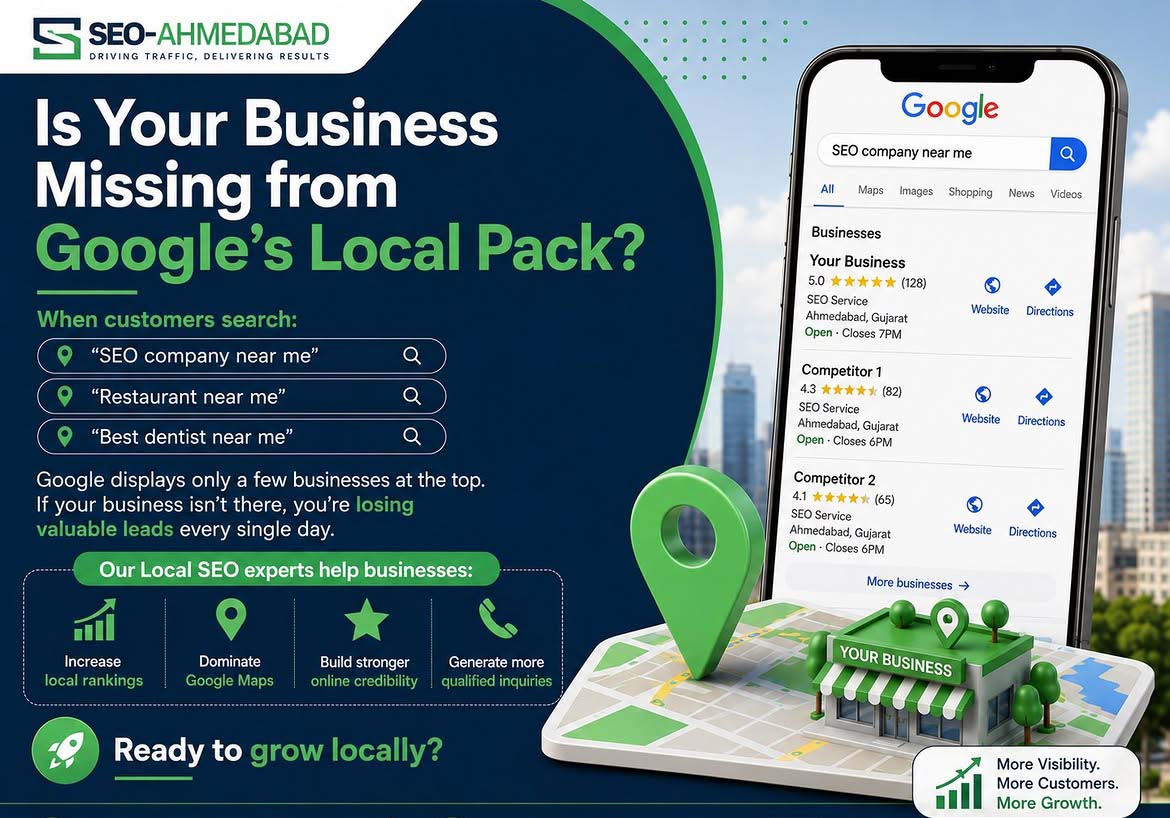
Hotels are inherently location-based businesses, making local SEO particularly important. Hotel SEO services in Ahmedabad can include optimizing local search signals so that travelers can discover the property when searching for accommodation in or around Ahmedabad.
Important local SEO elements include:
- Accurate business information
- Google Business Profile optimization
- Consistent name, address, and phone details
- Relevant business categories
- Hotel photos
- Reviews
- Location-focused website content
- Local citations
- Relevant local backlinks
A hotel should also make its physical location easy to understand.
Include useful information such as:
- Distance from the airport
- Distance from railway stations
- Nearby business districts
- Nearby tourist attractions
- Major roads
- Shopping areas
- Hospitals or corporate hubs where relevant
This can help both search engines and travelers understand the property’s location.
5. Optimize for High-Intent Keywords
Not every keyword is equally valuable. A hotel may receive thousands of impressions for a broad travel-related keyword but generate more bookings from a smaller number of highly relevant searches.
High-intent keywords may include terms related to:
- Hotel location
- Room type
- Price
- Amenities
- Business travel
- Family accommodation
- Events
- Specific nearby destinations
For example, a hotel offering conference facilities may benefit from targeting searches related to conference hotels or business accommodation. Keyword research should therefore consider both search volume and booking intent.
6. Create Helpful Location-Based Content
Travelers often search for information before choosing a hotel.
A hotel can create useful content around topics such as:
- Things to do in Ahmedabad
- Best places to visit near the hotel
- Ahmedabad business travel guide
- Best restaurants near the hotel
- Ahmedabad airport travel guide
- Weekend itinerary for Ahmedabad
- Places to visit with family
- Business districts in Ahmedabad
- Ahmedabad event and wedding guide
This content can attract travelers earlier in their decision-making process. The content should naturally connect relevant destinations and experiences to the hotel’s location without turning every article into an advertisement. Useful content can build topical authority and provide additional organic entry points to the website.
7. Improve Hotel Website Speed
Website performance can affect both user experience and search visibility. A slow hotel website can be particularly problematic because it may contain:
- Large photographs
- Image galleries
- Videos
- Booking widgets
- Third-party scripts
- Tracking tools
Hotels should optimize:
- Image file sizes
- Image formats
- Browser caching
- JavaScript
- CSS
- Server response time
- Mobile performance
The objective is to create a fast experience without sacrificing the visual quality travelers expect from a hotel website. A visitor who cannot quickly access room information or booking options may leave before making a reservation.
8. Make the Website Mobile-Friendly
Many travelers research accommodation from smartphones. A hotel’s website should make it easy for mobile users to:
- View rooms
- Check amenities
- Find the location
- See photos
- Read reviews
- Contact the property
- Check availability
- Make a booking
Important buttons such as Book Now, Check Availability, or Contact Hotel should be easy to find. Avoid forcing users to zoom, scroll excessively, or navigate complicated menus. Mobile SEO and conversion optimization should work together.
9. Create Strong Title Tags and Meta Descriptions
Search snippets are often the first interaction a potential guest has with your hotel brand. A good title can communicate:
Hotel Name + Location + Key Advantage
For example:
Luxury Hotel in Ahmedabad | Business & Family Stay
A meta description can highlight:
- Location
- Hotel category
- Key amenities
- Direct booking benefit
- Relevant experience
The goal is to accurately describe the page while encouraging qualified users to click. Do not fill titles and descriptions with repetitive keywords.
10. Optimize the Google Business Profile
For location-based hotel searches, Google Business Profile visibility can be extremely valuable.
Keep your profile updated with:
- Correct address
- Phone number
- Website
- Hotel category
- Photos
- Amenities
- Business hours where applicable
- Booking information
- Guest reviews
Encourage genuine guests to leave reviews and respond professionally to them. Reviews can influence user trust even when they do not directly determine organic rankings. A strong local presence can complement the hotel’s website SEO strategy.
11. Use Hotel and Local Business Structured Data Correctly
Structured data can help search engines understand information about a hotel. Depending on the website and implementation, relevant structured data may communicate information such as:
- Property name
- Address
- Contact information
- Images
- Amenities
- Location
- Services
Structured data should accurately represent visible website information. It should not be used to create misleading claims or manipulate search results. A technically correct implementation can make it easier for search engines to interpret important business information.
12. Build Dedicated Landing Pages for Important Searches
A hotel serving different types of guests can create targeted landing pages.
Examples include:
Business Travelers
Explain:
- Business-friendly rooms
- Wi-Fi
- Workspace
- Meeting facilities
- Nearby corporate locations
Families
Highlight:
- Room configurations
- Dining
- Nearby attractions
- Family-friendly amenities
Weddings and Events
Show:
- Banquet spaces
- Capacity
- Catering
- Event facilities
- Accommodation options
Airport Travelers
Provide:
- Distance from airport
- Transportation options
- Check-in information
- Parking
- Nearby attractions
Each page should provide genuine value rather than simply repeating the same content with different keywords.
13. Improve Direct Booking Conversion Rates
Getting organic traffic is only half the job. The website must also make booking easy.
A strong direct booking experience should provide:
- Clearly visible booking buttons
- Simple navigation
- Room information
- High-quality photos
- Transparent pricing where possible
- Availability information
- Secure booking process
- Mobile-friendly checkout
- Contact information
Make the direct booking option visible throughout the website. For example, a visitor reading a room page should not have to return to the homepage to find the booking button.
14. Use Content to Answer Guest Questions
Potential guests often have questions before booking. Create useful FAQ content around topics such as:
- Check-in and check-out
- Parking
- Breakfast
- Wi-Fi
- Airport access
- Pet policies
- Cancellation
- Extra beds
- Family accommodation
- Meeting facilities
Answer these questions clearly on the relevant pages. This can reduce uncertainty and help users decide whether your property meets their requirements. It can also capture longer, conversational search queries.
15. Build Quality Backlinks
Backlinks can contribute to a hotel’s authority and online visibility.
Potential sources include:
- Local tourism websites
- Travel publications
- Business directories
- Local news websites
- Event websites
- Hospitality publications
- Relevant travel blogs
Focus on relevance and quality. Avoid purchasing large quantities of low-quality backlinks simply to increase the backlink count. A smaller number of relevant, credible links can be more useful than hundreds of unrelated links.
16. Use Reviews as a Trust Signal
Travelers frequently compare hotels based on guest experiences. Encourage genuine customers to review your property on appropriate platforms. Your website can also feature authentic testimonials where appropriate. Respond to reviews professionally and consistently. Do not manufacture reviews or offer misleading incentives. The objective is to build genuine trust around the hotel brand.
17. Optimize Images for Hotel SEO
Images are especially important for hotels because travelers want to see the property before booking.
Optimize:
- Room photographs
- Property images
- Restaurant images
- Event spaces
- Amenities
- Exterior photographs
Use descriptive filenames and appropriate alternative text. Compress images without significantly reducing visual quality. A visually attractive website can be an important part of conversion optimization, while technical image optimization helps prevent large media files from slowing the site.
18. Target Nearby Attractions and Locations
Location-based searches can bring highly relevant visitors.
Create useful pages or content around nearby:
- Tourist attractions
- Business districts
- Shopping centres
- Airports
- Railway stations
- Convention centres
- Hospitals
- Universities
- Corporate parks
For example, a hotel located near an important business district can explain the property’s distance, transportation options, and suitability for business travelers. This creates useful information rather than simply inserting location keywords into existing content.
19. Track the Right SEO Metrics
A hotel should measure more than keyword rankings.
Important metrics include:
- Organic traffic
- Organic conversions
- Direct booking enquiries
- Booking transactions
- Booking-page visits
- Phone calls
- Contact-form submissions
- Local search visibility
- Google Business Profile interactions
- Revenue from organic traffic
The ultimate objective is business growth. A keyword ranking at position one is valuable only when it attracts relevant visitors and contributes to meaningful outcomes.
20. Work With a Specialized Hotel SEO Agency
Hotel SEO combines traditional search optimization with local visibility, travel-related content, conversion optimization, and hospitality-specific user intent. A specialized hotel SEO agency in Ahmedabad can develop a strategy around:
- Keyword research
- Technical SEO
- Local SEO
- Content marketing
- On-page optimization
- Link building
- Conversion optimization
- Analytics
- Competitor research
A hotel should expect a strategy based on its property, location, audience, competitors, and booking goals rather than a generic SEO package.
Hotel SEO vs Traditional SEO
Hotel websites have several unique SEO requirements.
| Traditional Business SEO | Hotel Website SEO |
|---|---|
| Product/service pages | Room and amenity pages |
| General local SEO | Strong location-based search |
| Service keywords | Accommodation and travel intent |
| Lead forms | Booking engine |
| General content | Travel and destination content |
| Business reviews | Guest reviews |
| Service enquiries | Direct reservations |
This makes hospitality SEO a specialized area of search marketing.
How Hotel Resort SEO Services Can Support Revenue
Properties offering both accommodation and leisure experiences may need broader optimization. Hotel resort SEO services in Ahmedabad can target searches related to:
- Resort stays
- Weekend getaways
- Family stays
- Events
- Weddings
- Dining
- Recreational facilities
- Corporate retreats
A resort website should clearly communicate its complete experience rather than focusing exclusively on room rates. Dedicated pages for amenities and experiences can capture additional search intent.
Get a Free Hotel SEO Audit
How Hotel Search Engine Optimization Services Can Create Long-Term Value
Paid advertising can provide immediate visibility, but organic SEO can create an asset that continues generating traffic after individual campaigns end. Hotel search engine optimization services in Ahmedabad can focus on building:
- Search visibility
- Topical authority
- Local relevance
- Website usability
- Organic traffic
- Brand discovery
- Direct booking opportunities
SEO still requires ongoing investment. Competitors publish new content, search algorithms evolve, and traveler behavior changes. A hotel should therefore treat SEO as an ongoing marketing channel rather than a one-time website project.
Common Hotel SEO Mistakes to Avoid
Relying Only on OTA Listings
Third-party platforms should not be the hotel’s only source of online visibility.
Using Duplicate Room Descriptions
Each important page should provide useful, unique information.
Ignoring Local SEO
A hotel needs strong location signals because guests search by destination and proximity.
Hiding the Booking Button
Make direct booking options easy to find.
Using Poor-Quality Images
Hotel guests want to understand the property visually.
Creating Thin Location Pages
Location pages should offer useful information rather than keyword-filled text.
Ignoring Mobile Users
A difficult mobile booking experience can result in lost conversions.
Buying Low-Quality Backlinks
Focus on relevant and trustworthy sources.
How to Create a Hotel SEO Strategy in Ahmedabad
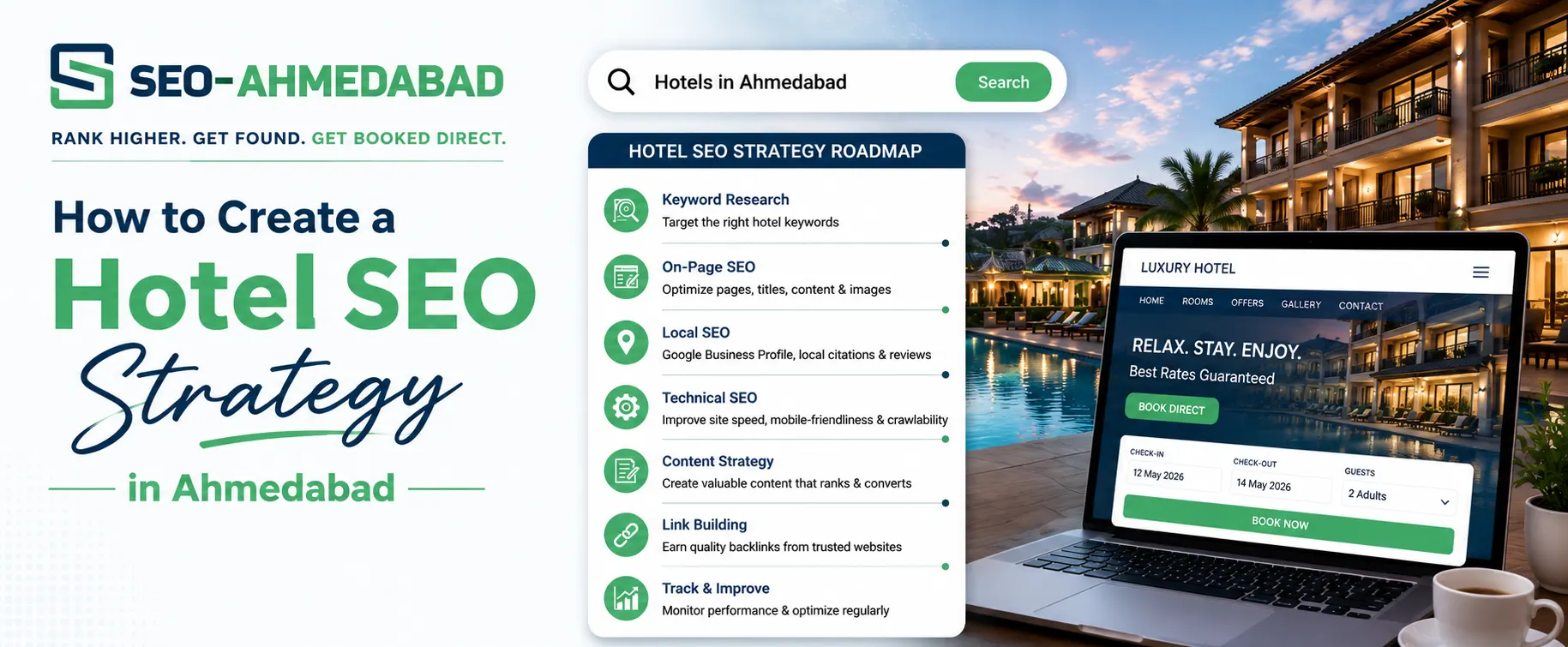
A practical strategy can follow these stages:
Month 1: Research and Audit
- Technical SEO audit
- Keyword research
- Competitor analysis
- Local SEO review
- Website conversion review
Month 2: On-Page Optimization
- Title tags
- Meta descriptions
- Headings
- Room pages
- Service pages
- Location pages
- Internal links
Month 3: Content and Authority
- Travel guides
- Local content
- FAQs
- Digital PR
- Relevant backlinks
- Local citations
Ongoing
- Monitor rankings
- Analyze organic conversions
- Update content
- Improve Core Web Vitals
- Optimize booking journeys
- Track competitors
The exact timeline will vary depending on the hotel’s existing website, competition, authority, and technical condition.
Final Thoughts
A hotel’s website should do more than display beautiful photographs and room information. It should actively attract travelers from search engines, answer their questions, build confidence, and make direct booking simple. Effective hotel website SEO services in Ahmedabad can support this process by combining technical optimization, keyword research, local SEO, useful content, website performance improvements, and conversion-focused design.
Hotels should focus on attracting visitors who are genuinely interested in staying at the property rather than chasing traffic for its own sake. Location-specific pages, room content, amenity information, travel guides, FAQs, and strong local search signals can all contribute to a more comprehensive organic strategy.
Seo-Ahmedabad.com can help hotels develop an SEO strategy focused on organic visibility, relevant traffic, and direct booking opportunities. When evaluating hotel SEO marketing in Ahmedabad, ask how the agency plans to measure business outcomes. Rankings and traffic are useful indicators, but direct bookings, enquiries, booking-page engagement, and organic revenue provide a clearer picture of SEO performance.
For hotels and resorts, SEO is not simply about appearing higher in Google. It is about being visible when travelers research where to stay, giving them the information they need, and making it easy to choose your property.
A consistent strategy can help build stronger organic visibility over time and create an additional channel for direct reservations. Seo-Ahmedabad.com provides hotel-focused SEO support tailored to the property’s location, audience, competitors, website, and direct booking objectives.
