

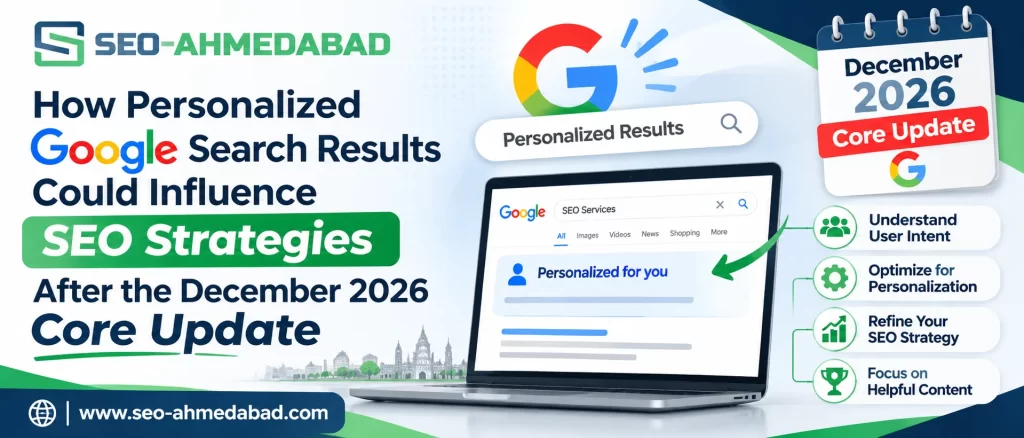
Google Search is evolving to understand more detailed queries and deliver results that better match individual users’ interests. Its pre-announced December 2026 Core Update is expected to focus on improvements in how its systems understand and rank relevant content, including longer and more complex questions, as well as personalised results for users who have personalisation enabled.
For website owners, SEO professionals, and digital marketers, this announcement raises an important question: could personalised search results change how websites attract organic traffic and maintain rankings?
The answer is that SEO strategies may need to place greater emphasis on satisfying different search intents, publishing genuinely useful content, and measuring performance across a wider range of queries. Businesses should not assume that every user will see identical search results or that personalization will automatically change every website’s rankings.
How Could Personalised Google Search Results Influence SEO After the December 2026 Core Update?
Personalised search can influence which results individual users see, depending on factors such as their search activity and personalisation settings. Google’s December 2026 Core Update is scheduled to improve personalised results for users who have this feature enabled.
SEO professionals should prepare by:
- Creating content that answers different but closely related user questions.
- Understanding informational, commercial, and transactional search intent.
- Improving content quality, relevance, and first-hand usefulness.
- Building clear topic coverage rather than publishing repetitive keyword-focused pages.
- Optimising for longer and more specific search queries.
- Monitoring search performance across pages, queries, devices, and locations.
- Evaluating conversions and engagement alongside organic rankings.
The goal is not to create a separate page for every possible user preference. It is to provide useful, relevant information that meets the needs of different audiences.
1. Understanding Personalised Google Search Results
Personalised Google Search results are results that may be adjusted according to information associated with a user’s search experience and personalisation settings.
For example, two people searching for a similar topic may sometimes see different ordering or presentation of results. One person may be more interested in detailed guides, while another may frequently engage with videos or local business information.
Personalisation does not mean that Google completely changes its ranking system for every individual. It can influence the results or result formats shown in some circumstances, while relevance to the search query remains important.
For businesses, this means that tracking a single keyword position does not always provide a complete picture of organic visibility.
SEO teams should examine broader performance indicators, including impressions, clicks, relevant queries, landing-page engagement, and conversions.
2. What the December 2026 Core Update Means for SEO
Google announced the December 2026 Core Update in advance on 24 November 2026. The announcement says the update will focus on improvements to how its systems understand and rank relevant content, including longer and more complex questions, and on improving personalised results for users who have personalisation enabled.
The update is scheduled for release in December 2026 and applies across the locations and languages where Google Search is available.
This announcement suggests two areas worth preparing for:
Better understanding of complex searches: Websites should provide clear, complete answers to detailed questions rather than relying only on short, broad keyword phrases.
Improved personalised results: Search visibility may vary more according to personalisation settings and user context in some situations.
However, Google has not published a guaranteed ranking formula or confirmed that every website will experience a ranking change. Businesses should avoid making major website changes based on speculation before the rollout.
3. Why Search Intent Will Become Even More Important
Search intent describes what a person wants to achieve when entering a query into Google. Understanding it helps businesses create pages that satisfy actual user needs.
For example, someone searching for “SEO services in Ahmedabad” may want to compare agencies, while someone searching “how much do SEO services cost in Ahmedabad” may be closer to making a purchasing decision.
A strong SEO strategy should address different stages of the customer journey.
Informational intent
Users want to learn about a topic, understand a problem, or find instructions.
Examples:
- What is AI SEO?
- How does local SEO work?
- How can a website improve organic traffic?
Commercial investigation intent
Users are comparing services, providers, products, or solutions.
Examples:
- Best SEO agency in Ahmedabad.
- SEO services versus PPC advertising.
- How to choose an SEO company.
Transactional intent
Users are ready to contact a business, request a quotation, or purchase a service.
Examples:
- Hire an SEO consultant in Ahmedabad.
- Book an SEO audit.
- Request local SEO services.
A website that covers these search intents with useful, clearly organised pages can reach potential customers at different stages of decision-making.
4. Build Content Around Longer and More Complex Search Queries
One of the key points in Google’s announcement is its focus on understanding and ranking content for longer and more complex questions.
This makes it important to move beyond short keyword targeting and understand how people naturally search.
For example, instead of targeting only “SEO services“, a business could create useful content addressing questions such as:
- How can small businesses improve local search visibility?
- What should an Ahmedabad business check before hiring an SEO agency?
- How long does SEO take to generate qualified enquiries?
- How can businesses improve visibility in AI-powered search results?
These questions provide opportunities to explain processes, answer concerns, and demonstrate subject knowledge.
However, avoid creating dozens of nearly identical pages for minor keyword variations. Combine closely related questions where one comprehensive page can satisfy the user’s needs.
5. Develop a Helpful Content SEO Strategy for 2026
Content quality should remain central to your SEO strategy. Publishing more articles does not automatically improve rankings. Each page should provide a clear purpose and offer information that is useful to its intended audience.
A practical approach includes:
Provide direct answers: Explain the main topic early in the article instead of making readers search through lengthy introductions.
Add original insights: Include practical examples, genuine experience, original research, and useful observations.
Demonstrate expertise: Use accurate information, relevant author credentials, and appropriate technical explanations.
Remove unnecessary repetition: Avoid adding paragraphs simply to increase word count or repeat keywords.
Keep information updated: Review important pages when services, products, regulations, or industry practices change.
Organise content logically: Use descriptive headings, short paragraphs, lists, and relevant internal links.
For businesses publishing AI-assisted content, editorial review is particularly important. AI can support research and drafting, but the final content should be accurate, original, useful, and checked by someone with appropriate subject knowledge.
6. Strengthen Topic Coverage Instead of Chasing Individual Rankings
A website may publish several articles targeting similar keywords without building meaningful topical depth. This can create repetitive content that offers little additional value.
A better approach is to organise content around important business topics.
For example, an SEO agency could create a central service page about local SEO and support it with relevant articles covering:
- Google Business Profile optimisation.
- Local keyword research.
- Local citation management.
- Review management.
- Location-page optimisation.
- Local SEO performance measurement.
Each supporting page should address a distinct user need and link naturally to relevant service information.
This structure helps visitors understand the subject and navigate to related information. It also gives search engines clearer context about the website’s content.
7. How to Measure SEO Performance in a Personalised Search Environment
Traditional keyword tracking remains useful, but it should not be the only way to evaluate SEO performance.
Google Search Console and Google Analytics 4 can help businesses understand how organic search contributes to website visibility and enquiries.
Monitor these indicators:
- Organic impressions: Understand how frequently pages appear in search results.
- Organic clicks: Measure visits generated from Google Search.
- Click-through rate: Identify pages that may need better titles or descriptions.
- Search queries: Discover the questions and terms bringing users to the website.
- Landing-page performance: Identify which pages attract relevant visitors.
- Conversions: Measure enquiries, calls, purchases, and other business outcomes.
- Engagement indicators: Review relevant GA4 engagement and conversion data.
Compare performance across date ranges and landing pages rather than reacting to a single keyword movement.
Remember that Search Console data is aggregated and does not provide a complete view of every individual’s personalised search results. Do not assume that a ranking report represents the exact experience of every searcher.
8. Prepare Your Website Before the December 2026 Rollout
Businesses can use the period before the rollout to review their existing SEO foundations.
A practical preparation checklist includes:
- Audit important landing pages: Check whether each page answers the intended search query.
- Review content quality: Remove outdated, repetitive, or unhelpful information.
- Analyse search intent: Confirm that informational and commercial pages serve different purposes.
- Improve internal linking: Connect relevant service pages, guides, and supporting resources.
- Check technical SEO: Review crawlability, indexability, mobile usability, and page performance.
- Review structured data: Ensure markup accurately reflects visible page content.
- Record baseline performance: Save Search Console and analytics data before the rollout.
- Monitor the rollout: Wait for the update to complete before drawing conclusions about its impact.
SEO-Ahmedabad.com can use this preparation framework to help businesses review content relevance, technical performance, and organic search opportunities without making unnecessary changes based on speculation.
9. What to Do If Your Website Loses Rankings After the Update
A ranking or traffic decline does not automatically mean that Google has penalised a website. Core updates can change how Google’s systems evaluate and rank relevant pages.
If your website experiences a decline, start with a structured investigation.
Step 1: Confirm the rollout status. Check the Google Search Status Dashboard and identify the official start and completion dates.
Step 2: Allow time for reliable comparison. Google recommends waiting until a core update is complete and then allowing at least a week before evaluating post-update Search Console data.
Step 3: Identify affected pages and queries. Compare performance before and after the update to determine whether the decline affects specific topics, page types, or the entire website.
Step 4: Review competing search results. Examine the pages now appearing for affected queries and identify differences in relevance, usefulness, and content coverage.
Step 5: Improve the actual weaknesses. Update content where necessary, improve user experience, fix technical issues, and add genuinely useful information.
Step 6: Monitor results. Track performance over an appropriate period rather than making repeated changes every few days.
Avoid changing titles, rewriting every page, or deleting large amounts of content without evidence of a problem.
Conclusion
Personalised search and improved understanding of complex queries are important areas highlighted in Google’s December 2026 Core Update announcement. For SEO professionals, the practical response is to build content that satisfies different search intents, provides direct and useful answers, and demonstrates genuine subject knowledge.
Businesses should also measure organic visibility using multiple performance indicators instead of relying exclusively on fixed keyword positions. Technical SEO, content relevance, clear website structure, and useful information remain important foundations.
A sustainable SEO strategy should focus on helping people find the right information and take meaningful action. Preparing your website around these principles is more valuable than chasing unconfirmed ranking factors or making sudden changes based on update speculation.
Frequently asked question
The update is scheduled to improve how Google understands and ranks relevant content, including longer and more complex questions, as well as personalised results for users who have personalisation enabled. Its actual impact on individual websites will become clearer after rollout.
Personalised search results are results that may be adjusted according to a user's search experience and personalisation settings. This can influence the ordering or presentation of some results, but does not mean every search produces completely different results.
Businesses should review content quality, search intent, technical SEO, internal linking, and website performance. They should also record baseline Search Console data before the rollout and monitor results after completion.
Websites should first identify which pages and queries have changed. Improvements should focus on content relevance, originality, usefulness, technical accessibility, and user experience rather than making unnecessary website-wide changes.
Start by confirming the update's completion, comparing Search Console performance, and identifying affected pages and queries. Review competing results, improve genuine content weaknesses, and monitor performance over time. Recovery is not guaranteed by any single SEO change.
