

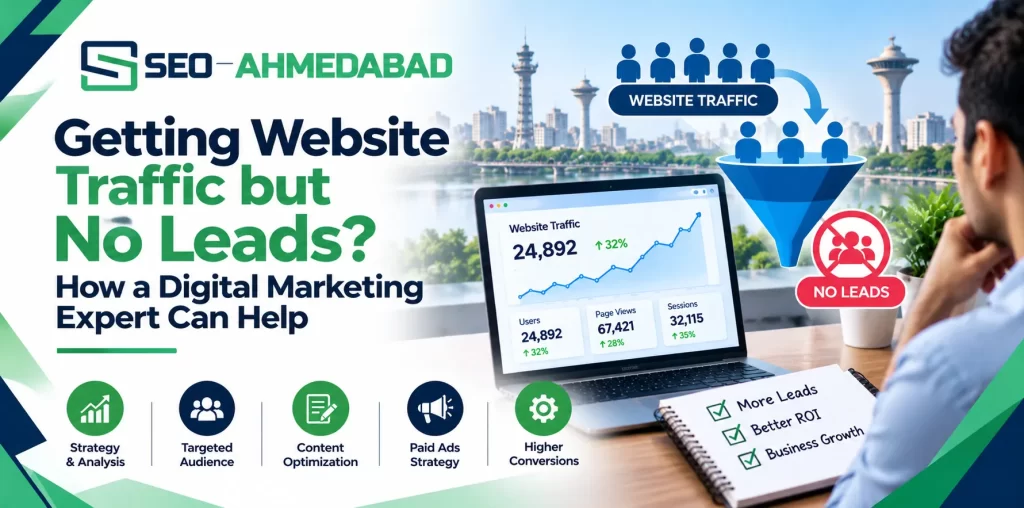
Getting visitors to your website is an important step toward business growth, but traffic alone does not guarantee enquiries, phone calls, or sales. If people are visiting your website without contacting your business, the problem may lie in your audience targeting, website experience, content, or conversion process.
Many businesses invest in search engine optimization, social media marketing, and paid advertising without understanding which activities generate qualified leads. The result can be increasing website traffic without meaningful business outcomes.
A structured digital marketing strategy helps identify where potential customers are dropping off and what needs to improve. Working with a Digital Marketing Expert in Ahmedabad can help businesses evaluate their online presence, reach relevant audiences, and turn more suitable website visitors into enquiries.
How Can a Digital Marketing Expert Turn Website Traffic into Leads?
A digital marketing expert helps convert website traffic into leads by attracting the right audience, improving landing pages, creating relevant content, and measuring conversion performance.
Key steps include:
- Analyze website traffic: Identify which channels and pages attract relevant visitors.
- Improve targeting: Focus SEO and advertising on people searching for your products or services.
- Optimize landing pages: Communicate your value clearly and make contacting your business easy.
- Build trust: Add genuine testimonials, case studies, service details, and useful information.
- Track conversions: Measure calls, form submissions, bookings, and other meaningful actions.
- Improve follow-up: Respond promptly to enquiries and monitor lead quality.
The right strategy depends on your business goals, audience, competition, and website performance. More traffic is not always the solution; attracting relevant visitors and improving the conversion journey may deliver better results.
1. Identify Why Your Website Traffic Is Not Converting
Before spending more money on marketing, determine why visitors are not taking action. A website can attract thousands of visitors and still generate very few qualified enquiries if the traffic is irrelevant or the website does not meet visitors’ expectations.
Start by examining your website analytics and customer journey. Look at the pages attracting visitors, the search terms bringing them to your site, and the actions people take before leaving.
Common problems include:
- Visitors arriving through irrelevant keywords or advertisements.
- Unclear service descriptions or pricing information.
- Missing or difficult-to-find contact details.
- Slow loading pages or poor mobile usability.
- Complicated enquiry forms.
- Weak calls to action.
- Limited trust signals or outdated website content.
- Incorrect or incomplete conversion tracking.
A professional audit can help distinguish between traffic quality problems and website conversion problems. For example, if visitors leave a service page without exploring further, the content or page experience may need improvement. If users submit enquiries but rarely become customers, the issue may involve lead quality, pricing, or sales follow-up.
2. Attract the Right Audience Through SEO
Search engine optimization can help your business reach people who are actively looking for relevant products, services, or information. However, ranking for high-volume keywords does not automatically produce qualified leads.
The goal should be to target search terms that reflect your customers’ needs and buying intent. Someone searching for general information may be at an early research stage, while someone searching for a specific service in Ahmedabad may be closer to contacting a provider.
An effective SEO strategy includes keyword research, technical optimization, helpful content, internal linking, and relevant landing pages.
A digital marketing professional can help you:
- Identify keywords aligned with your services and customer intent.
- Improve page titles, headings, and descriptions.
- Create service pages that answer customer questions.
- Fix indexing, crawlability, and website structure issues.
- Strengthen local SEO for relevant geographic searches.
- Review organic traffic and conversion performance.
SEO should focus on attracting relevant visitors rather than increasing traffic at any cost. Measure the quality of enquiries generated by organic search alongside impressions, clicks, and rankings.
3. Improve Landing Pages and Calls to Action
Your landing page plays a major role in converting visitors into leads. If people cannot quickly understand what you offer, why it matters, or how to contact you, they may leave without taking action.
A strong landing page communicates its main benefit clearly and guides visitors toward one primary action. Depending on your business, that action might be requesting a quotation, booking a consultation, calling your team, or completing an enquiry form.
Consider these improvements:
Write a clear headline: Explain the service and the problem it solves.
Highlight relevant benefits: Show how your offering helps customers rather than relying on vague promotional language.
Use visible calls to action: Place enquiry buttons and contact details where visitors can easily find them.
Reduce form friction: Ask only for the information necessary to respond to an enquiry.
Build credibility: Include genuine reviews, relevant experience, project examples, or transparent service information.
Optimize mobile usability: Ensure buttons, text, forms, and navigation work properly on smaller screens.
Test changes using actual conversion data. A redesigned page should be evaluated on completed enquiries and lead quality, not simply appearance or time spent on the page.
4. Use Paid Advertising More Strategically
Paid advertising can bring relevant visitors to your website quickly, but poorly targeted campaigns can consume a budget without generating useful enquiries.
Before launching or expanding campaigns, define your ideal customer, service area, budget, and desired conversion. Search advertising may work well when people actively seek a service, while social media campaigns may help introduce an offer to relevant audiences.
To improve performance:
- Choose targeting options that match your business objectives.
- Use relevant keywords and exclude unsuitable searches where appropriate.
- Align advertisements with the content of their landing pages.
- Test different messages and offers systematically.
- Track calls, form submissions, and qualified leads.
- Review cost per lead and lead-to-customer conversion rates.
A campaign generating many enquiries is not necessarily successful if those enquiries are irrelevant or unlikely to become customers. Evaluate lead quality and business value before increasing advertising expenditure.
5. Create Content That Builds Trust
Visitors may need more information before they feel comfortable contacting a business. Helpful content can answer their questions, explain your services, and demonstrate your understanding of their problems.
Depending on your industry, useful content may include service guides, comparison articles, frequently asked questions, case studies, pricing explanations, and practical how-to resources.
Content should match the visitor’s stage in the buying journey. An informational article can help someone understand a problem, while a detailed service page can help a potential customer compare solutions and take the next step.
SEO Ahmedabad can help businesses assess how search visibility, useful content, and website conversion opportunities work together to support lead generation.
Avoid publishing generic articles simply to include keywords. Each page should offer accurate, relevant information and provide a logical next step for readers who need your services.
6. Build Trust and Improve Local Visibility
Customers are more likely to contact a business when they can understand its services, verify its credibility, and find accurate contact information.
For businesses serving Ahmedabad, local SEO can help improve discovery for relevant location-based searches. Maintain an accurate Google Business Profile, keep important business details consistent, and create service pages that genuinely reflect your offerings and service areas.
You can also strengthen trust by providing:
- Clear service descriptions and business contact details.
- Genuine customer reviews and testimonials.
- Relevant case studies or examples of completed work.
- Transparent information about your process.
- Helpful answers to common customer questions.
- A professional, secure, and easy-to-navigate website.
Trust signals should be authentic. Avoid fabricated testimonials, unsupported claims, or misleading location pages. The objective is to help potential customers make informed decisions and feel confident about contacting your business.
7. Track Leads and Measure What Matters
Without accurate tracking, it is difficult to know which marketing activities generate meaningful results. Businesses should define what counts as a lead and measure those actions consistently.
Important metrics include:
- Qualified leads: Enquiries that match your target customer profile.
- Conversion rate: The percentage of relevant visitors who complete a desired action.
- Cost per lead: Marketing expenditure divided by the number of leads generated.
- Lead-to-customer rate: The percentage of leads that become paying customers.
- Customer acquisition cost: The cost associated with acquiring a customer.
- Revenue contribution: The business value associated with marketing-generated leads.
Use analytics and advertising platforms to track relevant actions, such as form submissions, phone calls, bookings, and purchases. Check that tracking is working correctly and respects applicable privacy and consent requirements.
Review results regularly. If a page attracts relevant visitors but produces few enquiries, test the content and calls to action. If leads are coming in but not converting into customers, review response times, qualification, pricing, and the sales process.
8. Choose the Right Digital Marketing Professional
When you hire Digital Marketing Expert in Ahmedabad, look for someone who understands your business goals and can explain how marketing activities will support them.
Before choosing a freelancer or agency, ask how they will assess your website, identify opportunities, measure qualified leads, and report progress. Request clear information about deliverables, campaign management, budgets, and communication.
A suitable professional should prioritize measurable improvements rather than promise guaranteed rankings or a fixed number of leads. They should also explain which activities need time, which can be tested quickly, and how the strategy will change based on performance data.
At SEO Ahmedabad, businesses can explore a structured approach to improving search visibility, website performance, and lead-generation opportunities based on their marketing objectives.
Conclusion
Getting website traffic without generating leads can indicate a mismatch between audience targeting, website content, user experience, and conversion strategy. The solution starts with identifying the problem rather than automatically increasing traffic or advertising expenditure.
By improving SEO, refining landing pages, creating useful content, building trust, and measuring qualified enquiries, businesses can make better decisions about their marketing investment. A data-driven approach helps turn website visitors into more meaningful opportunities for business growth.
Frequently asked question
Possible causes include irrelevant traffic, unclear service pages, weak calls to action, slow loading times, complicated forms, limited trust signals, or inaccurate conversion tracking. A website and marketing audit can help identify the main issue.
A specialist can improve audience targeting, SEO, paid campaigns, landing pages, content, and conversion tracking to attract relevant visitors and make it easier for them to contact your business.
A freelancer may suit a focused project or a smaller budget, while an agency may provide a broader range of services. Compare expertise, deliverables, communication, and reporting before deciding.
Some website and advertising improvements can be tested relatively quickly, while SEO and content strategies often require sustained effort. Results depend on competition, website quality, budget, and the offer.
Monitor qualified leads, conversion rates, cost per lead, lead-to-customer rates, and revenue contribution. Website traffic and clicks are useful indicators, but they do not show the full business impact.
