

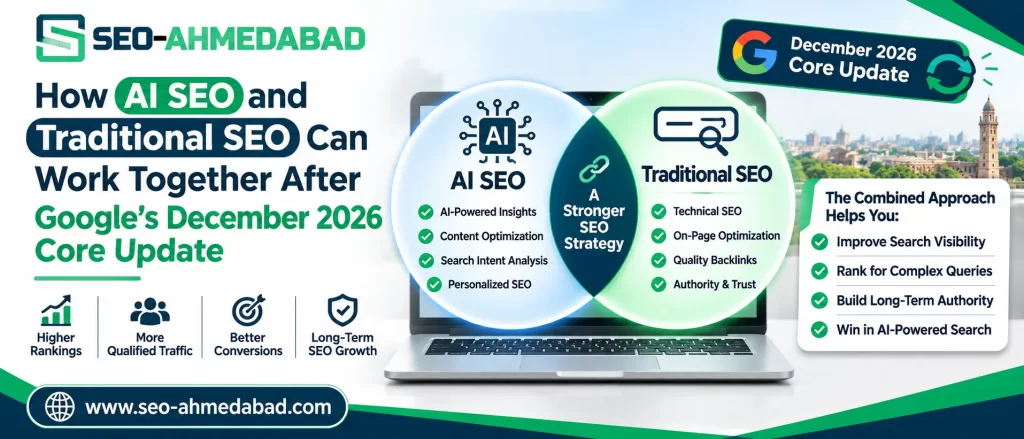
Search engine optimisation is changing as Google improves how it understands complex queries, evaluates relevant content, and presents personalised search results. With the December 2026 Core Update expected to introduce further improvements to these areas, businesses are looking for ways to maintain organic visibility while preparing for AI-powered search experiences.
This has raised an important question for digital marketers: should businesses focus on traditional SEO or invest in AI SEO?
The better approach is to combine both. Traditional SEO builds the technical foundation, content quality, website structure, and search visibility that websites need. AI SEO extends this approach by improving how content answers conversational questions, communicates expertise, and supports discovery through AI-powered search experiences.
For businesses, combining these methods can create a more balanced strategy for organic traffic, relevant enquiries, and long-term search performance.
How Can AI SEO and Traditional SEO Work Together?
AI SEO and traditional SEO work together by combining established search optimisation practices with content improvements designed for AI-powered discovery.
- Traditional SEO: Focuses on technical SEO, keyword research, on-page optimisation, internal linking, backlinks, and organic rankings.
- AI SEO: Focuses on conversational search queries, direct answers, semantic relevance, structured information, and visibility across AI-powered search experiences.
- Shared foundation: Both approaches require helpful content, clear website structure, accurate information, and a positive user experience.
- Combined strategy: Use traditional SEO to build website quality and AI SEO to make content easier to understand and retrieve for complex questions.
- Performance measurement: Monitor organic clicks, impressions, conversions, and relevant visibility rather than relying on one ranking position.
The objective is not to replace traditional SEO with AI SEO. It is to make both approaches support the same business and search visibility goals.
1. Understanding Traditional SEO and AI SEO
Before combining these approaches, businesses should understand what each one involves.
What Is Traditional SEO?
Traditional SEO is the process of improving a website’s visibility in organic search results through established optimisation practices.
It includes:
- Keyword research and search intent analysis.
- Technical SEO and website crawlability.
- On-page optimisation.
- Content creation and optimisation.
- Internal linking and website architecture.
- Relevant link earning and digital authority.
- Mobile usability and page experience.
- Organic traffic and conversion tracking.
For example, a business offering SEO services in Ahmedabad may optimise its service pages for local search terms, create useful blogs, improve page speed, and build relevant internal links.
These activities help search engines discover, understand, and evaluate website content.
What Is AI SEO?
AI SEO focuses on preparing website content for discovery and understanding across AI-powered search experiences.
These may include Google AI Overviews, AI-powered search features, and conversational search platforms.
AI SEO activities can include:
- Creating direct answers to specific user questions.
- Covering related topics and search intents.
- Improving content clarity and structure.
- Adding accurate and relevant structured data.
- Demonstrating practical knowledge and expertise.
- Creating content that addresses conversational queries.
- Keeping information accurate and up to date.
AI SEO does not mean writing content exclusively for AI systems. Useful information for people remains the foundation.
2. What the December 2026 Core Update Means for Both SEO Approaches
Google announced its December 2026 Core Update in advance. Its announcement highlights improvements to how Google’s systems understand and rank relevant content, including longer and more complex questions, as well as personalised results for users who have personalisation enabled.
This makes the update particularly relevant to businesses considering how traditional SEO and AI-focused optimisation should work together.
Traditional SEO remains important because websites need to be discoverable, crawlable, technically accessible, and relevant to search queries.
AI-focused optimisation can complement those foundations by making content easier to interpret and by addressing more detailed questions that people may ask through modern search experiences.
However, businesses should not assume that the update introduces a completely separate AI ranking system or that every website will experience the same ranking changes.
A sensible preparation strategy is to strengthen existing SEO foundations while improving the usefulness and clarity of content.
3. Combine Traditional Keyword Research with Conversational Search Intent
Keyword research remains important, but businesses should understand more than search volume and exact-match phrases.
Traditional SEO often begins with identifying keywords that potential customers use when searching for a product or service.
AI-focused optimisation adds another layer: understanding the complete questions, concerns, and follow-up searches behind those keywords.
For example, an Ahmedabad business searching for SEO services may also want to know:
- How much do SEO services cost?
- How long does SEO take to generate leads?
- What is the difference between SEO and AI SEO?
- Can AI SEO improve visibility in Google AI Overviews?
- How should a small business choose an SEO agency?
A useful content strategy can connect these questions to relevant service pages, comparison guides, and detailed educational articles.
Practical recommendation: Create a keyword map that includes primary keywords, secondary keywords, long-tail questions, and commercial search intent. Use each topic where it genuinely helps the reader.
4. Build High-Quality Content for Traditional and AI Search
Content is where traditional SEO and AI SEO have significant overlap.
Traditional SEO requires pages to satisfy the search intent behind a query. AI-focused optimisation also benefits from content that provides clear, accurate, and useful answers.
A strong article should include:
A clear introduction: Explain the topic and why it matters to the reader.
A direct answer: Provide a concise explanation near the beginning.
Descriptive headings: Organise information into meaningful H2 and H3 sections.
Practical examples: Use real scenarios, relevant data, or industry-specific explanations.
Supporting evidence: Reference reliable sources where appropriate.
Useful FAQs: Address genuine follow-up questions rather than repeating the article.
Relevant internal links: Connect supporting articles to important service or category pages.
For example, an article about local SEO should explain what local SEO involves, how businesses can improve local visibility, which metrics matter, and when professional support may be useful.
Avoid publishing multiple articles that repeat nearly identical information simply to target slightly different keywords.
5. Improve Technical SEO Before Expanding AI SEO Activities
AI-focused content optimisation cannot compensate for fundamental website problems.
A website should have a technically sound foundation so that search engines can discover and process its important pages.
Important traditional SEO checks include:
- Crawlability: Ensure search engines can access important website content.
- Indexability: Check that valuable pages are not accidentally blocked or marked noindex.
- XML sitemap: Keep the sitemap accurate and updated.
- Canonical tags: Use appropriate canonical URLs to manage duplicate or similar pages.
- Mobile usability: Ensure pages work properly on mobile devices.
- Page performance: Review loading speed and Core Web Vitals.
- Structured data: Use valid markup that accurately represents visible page information.
- Internal links: Make important content accessible through relevant links.
Structured data can help search engines understand page entities and content, but it does not guarantee rankings or AI Overview inclusion.
Google’s existing technical and content guidance should remain the starting point for website optimisation.
6. Use AEO and GEO as Supporting Parts of Your SEO Strategy
AI SEO is often discussed alongside Answer Engine Optimisation (AEO) and Generative Engine Optimisation (GEO).
These approaches can support a broader search strategy.
Answer Engine Optimisation (AEO)
AEO focuses on making content useful for direct-answer experiences.
Useful practices include:
- Answering common questions clearly.
- Using descriptive headings.
- Providing concise definitions.
- Explaining processes in logical steps.
- Adding relevant FAQs.
- Supporting factual statements with reliable sources.
Generative Engine Optimisation (GEO)
GEO focuses on improving the clarity, usefulness, and discoverability of information in generative AI experiences.
Practical activities include:
- Publishing original insights and useful explanations.
- Demonstrating genuine subject knowledge.
- Maintaining consistent business information.
- Providing clear product and service descriptions.
- Supporting important claims with credible references.
- Creating well-organised content around relevant topics.
Neither AEO nor GEO should be treated as a replacement for traditional SEO. They are complementary optimisation approaches, and visibility in AI-generated answers cannot be guaranteed.
7. Measure Performance Across Traditional and AI Search
One of the biggest mistakes businesses can make is evaluating their entire SEO strategy using only a few keyword rankings.
Traditional SEO and AI-focused optimisation require a broader measurement approach.
Use Google Search Console to monitor:
- Search impressions.
- Organic clicks.
- Click-through rates.
- Average position.
- Search queries.
- Page-level performance.
Use Google Analytics 4 to evaluate:
- Organic landing-page sessions.
- Engagement.
- Lead form submissions.
- Calls and other conversion events.
- Traffic quality and business outcomes.
For AI search visibility, businesses can also monitor referral traffic from identifiable AI platforms and manually review important queries across supported search experiences. These checks provide useful observations, but they are not a complete measurement of all AI-generated visibility.
Compare performance over consistent periods and avoid treating short-term fluctuations as proof of an algorithmic impact.
8. Prepare a Combined SEO Strategy After the December 2026 Core Update
Businesses can use the following framework to combine traditional SEO and AI SEO.
| SEO activity | Traditional SEO focus | AI SEO contribution |
|---|---|---|
| Keyword research | Search volume and competition | Conversational questions and intent |
| Content creation | Relevant keywords and page structure | Direct answers and contextual coverage |
| Technical SEO | Crawling and indexability | Clear, accessible content structure |
| On-page SEO | Titles, headings, metadata | Clear definitions and answer-focused sections |
| Authority | Relevant links and reputation | Credible sources and demonstrable expertise |
| Measurement | Rankings, clicks, impressions | Broader visibility and referral observations |
A practical implementation plan could look like this:
First month: Audit technical SEO, identify important landing pages, review keyword targeting, and record performance benchmarks.
Second month: Improve existing content, add useful answers, strengthen internal linking, and address technical problems.
Third month: Expand content around related customer questions, improve AEO and GEO practices, and review conversion tracking.
After the rollout: Compare performance, identify affected pages, and make evidence-based improvements rather than reacting to speculation.
9. What Should Businesses Avoid After a Google Core Update?
Businesses should avoid making rushed changes based on unverified ranking predictions.
Common mistakes include:
- Replacing traditional SEO completely with AI SEO.
- Publishing large volumes of low-value AI-generated articles.
- Repeating keywords unnaturally.
- Creating separate pages for every minor keyword variation.
- Adding structured data that does not match visible content.
- Making unnecessary changes to high-performing pages.
- Assuming a ranking decline automatically means a Google penalty.
- Expecting guaranteed inclusion in Google AI Overviews.
A better approach is to identify actual website weaknesses and improve the content or technical elements that need attention.
Conclusion
AI SEO and traditional SEO work best when they support one another. Traditional SEO provides the foundation through technical optimisation, relevant keywords, website structure, quality content, and organic search performance. AI SEO adds a focus on conversational questions, direct answers, semantic relevance, and visibility across emerging AI-powered search experiences.
The December 2026 Core Update makes it especially important to understand complex search intent and prepare useful content for different search needs. However, businesses should continue following established Google guidance instead of chasing unconfirmed ranking factors.
SEO-Ahmedabad can help businesses approach this transition through a balanced strategy that combines technical SEO, content optimisation, AEO, and GEO.
The long-term objective is simple: build a website that people find useful, search engines can understand, and potential customers can trust.
Frequently asked question
Traditional SEO builds the foundation through technical optimisation, keyword research, content quality, and website structure. AI SEO complements it through conversational queries, direct answers, semantic relevance, and content clarity for AI-powered search experiences.
Google's announced update focuses on improving how its systems understand and rank relevant content, including longer and more complex questions, and personalised results for users with personalisation enabled. Its actual impact will become clearer after rollout.
Businesses should review content quality, technical SEO, search intent, internal linking, and website performance. They should record baseline performance and make improvements based on measurable website issues.
Traditional SEO improves organic search visibility through technical and content optimisation. AI SEO focuses on discoverability in AI-powered search experiences. AEO focuses on providing clear answers to users' questions. These approaches can complement one another.
Yes. Technical accessibility, relevant content, clear website structure, and useful information remain important foundations. However, traditional SEO practices alone do not guarantee visibility in AI-generated answers.
